


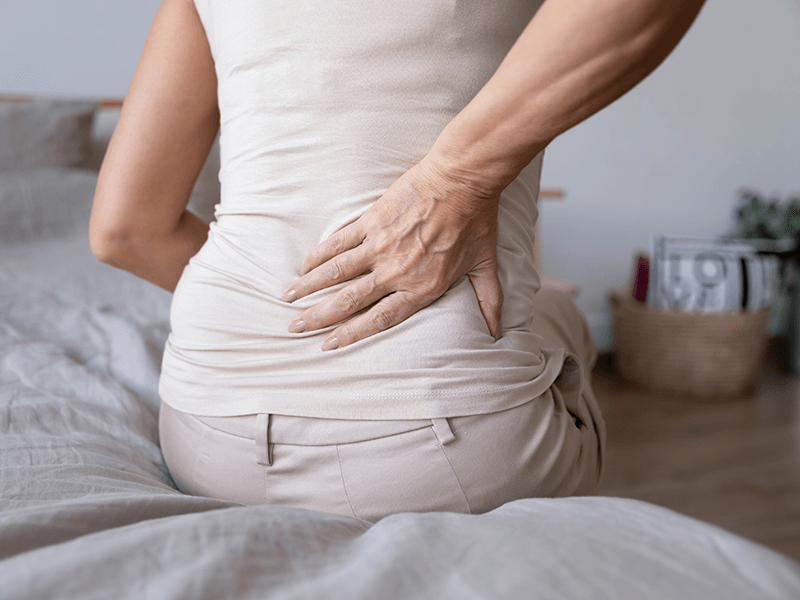
Lumbar disc herniation can significantly impact daily life, causing leg pain and numbness. While surgery is often the first thing that comes to mind when thinking about lumbar disc herniation, there are conditions for its suitability, and some people may not want to undergo surgery. There are other ways to prevent the worsening or recurrence of lumbar disc herniation besides surgery.
This section will explain lumbar disc herniation and stretching methods to treat it.
table of contents
What is a lumbar disc herniation?
"The "lumbar vertebrae" refer to the bones of the lower back. The bones of the lower back are part of the spine, from the spine to the hip bones, and all of these bones are made up of stacks of bones called vertebral bodies. The "intervertebral discs" act like adhesives, connecting the vertebral bodies.
Lumbar disc herniation occurs when the nucleus pulposus, a tissue within the intervertebral disc, protrudes for some reason, compressing the nerves. This nerve compression can cause leg pain and numbness, lower back pain, and difficulty walking.
reference)
Minds Guideline Library (Commissioned project by the Ministry of Health, Labour and Welfare)
https://minds.jcqhc.or.jp/n/pub/1/pub0017/G0000475
Stretching methods for lumbar disc herniation
If you suspect you have a lumbar disc herniation, you should first consult a doctor. Depending on your symptoms and the results of examinations, surgery may or may not be indicated. If your symptoms come and go throughout the day, or if the pain is decreasing day by day, you may be advised to wait and see without surgery. In some cases, the symptoms may disappear completely after a few months, but research suggests that daily exercise such as stretching is effective in preventing the symptoms from worsening and in preventing recurrence.
Therefore, we will explain the stretching method below. By performing stretches, it becomes possible to ① maintain the lumbar spine in a physiological forward-tilted position (avoid arching the lower back too much) and ② make the muscles around the waist and legs more flexible, which can help prevent the worsening and recurrence of lumbar disc herniation.
Knee-hugging stretch
Performing this stretch helps you maintain a posture that prevents excessive arching of the lower back. It also improves the stretch of the muscles that support the spine and the muscles in the buttocks.
- Lie on your back and hug both knees with both hands.
- While exhaling, bring your knees, which you've hugged to your chest, closer for 10 seconds.
When bringing your knees towards your chest, try to lift your hips off the floor as much as possible.
Waist twisting stretch
This stretch improves the mobility of the waist and corrects the habit of arching the lower back. It also improves the stretch of many muscles, including those that support the spine, as well as the muscles of the lower back, chest, upper back, abdomen, buttocks, and front of the thighs.
- Lie on your back with your legs slightly apart.
- Keep your buttocks on the floor and tilt your right leg to the left.
- Exhale and hold the position for 10 seconds.
- Do the same on the left side.
If possible, hold the fallen leg with your other hand. You'll feel a greater stretch.
A stretch where you put a towel around the sole of your foot and pull it.
This stretch improves the mobility of the waist and corrects the habit of arching the lower back. It also improves the stretch of the muscles in the back of the thighs and calves.
- Lie on your back with your knees bent and slightly apart.
- Hold a towel (about the size of a hand towel) in both hands and place it under the sole of your right foot.
- While lying on your back, extend your legs, which are wrapped in a towel, to an angle of about 60 degrees from the floor.
- Exhale and hold the position for 10 seconds.
- Do the same on the left side.
To achieve a comfortable level of stretch, compare towels of different lengths and adjust accordingly.
Stretch with both elbows raised and both knees bent
This stretch will lengthen your lumbar spine and also stretch the muscles in your abdomen and the front of your thighs.
- Lie face down and raise your upper body by supporting yourself on your elbows.
- As you exhale, bend both knees upwards and hold the position for 10 seconds.
Note: Tilting your head back will cause your lower back to arch too much, so keep your gaze on the floor.
Stretch the back of your thighs
Performing this stretch will lengthen the muscles in the back of your thighs and prevent excessive strain on your lumbar spine.
- From a standing position, squat down and grasp both ankles with both hands.
- Keeping your chest and the front of your thighs together, straighten both knees.
- Exhale and hold the position for 10 seconds.
Try to keep your chest and thighs together. If it's difficult to fully straighten your knees, you can keep them bent.
In all stretches, avoid stretching to the point of pain. Start with 1-2 repetitions and gradually increase the number. With continued practice, you will be able to stretch more easily. Continue stretching within your limits and over the long term.
When you should not stretch
If you experience unusual symptoms such as increased leg pain or numbness, difficulty walking, or worsening symptoms after stretching, please refrain from stretching and consult a doctor.
summary
This time, we explained lumbar disc herniation and stretching methods to treat it.
If you experience pain or numbness in your feet, first consult a doctor to discuss treatment options and whether stretching exercises are suitable for you. Once you start stretching, continue consistently within your limits to prevent worsening of the condition and recurrence.
reference)
Lumbar Disc Herniation Treatment Guidelines, Revised 2nd Edition
https://mail.google.com/mail/u/0/#inbox?projector=1
• Low Back Pain Treatment Guidelines 2019, Revised Edition No. 2
https://minds.jcqhc.or.jp/docs/gl_pdf/G0001110/4/Low_back_pain.pdf
All Japan Federation of Medical Cooperatives Why does lower back pain occur? Prevent it by strengthening your abdominal muscles. Lower back pain began with bipedal locomotion.
https://www.min-iren.gr.jp/?p=4119
・J⁻STAGE Physical Therapy
https://www.jstage.jst.go.jp/article/rigaku/44/6/44_11334/_article/-char/ja/
- All Japan Federation of Medical Workers' Unions: Lower back pain, lumbar spine, this difficult thing
https://www.min-iren.gr.jp/?p=7791
Supervised by: Dr. Yasushi Tsuda